Bridging the Behavioral Yield Gap: Why Workforce Behavior is the Real Driver of Estate Productivity
Explore how managing workforce behavioral gaps in field maintenance, pest control, and pruning unlocks hidden plantation yield, improves OER, and transforms AgriBusiness ROI.
The Hidden Friction in Plantation Management
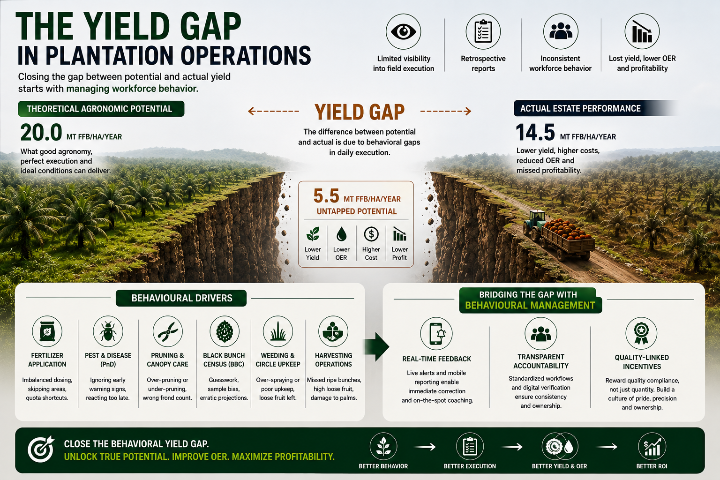
For years, agribusiness executives have invested heavily in high-yield seed varieties, advanced fertilizers, and mechanical harvesting equipment. Yet, across many commercial oil palm estates, a persistent problem remains: actual field output continuously falls short of theoretical agronomic potential.
Why does this "yield gap" persist?
In reality, operational breakdowns rarely occur because the agronomic science is flawed. The true bottleneck sits in human behavioral, the daily execution habits, operational friction, and quality decisions made by field workers, mandores, and estate supervisors across thousands of hectares.
When estate maintenance relies on manual paper logs, retrospective monthly reviews, or unverified field sampling, management loses visibility over critical tasks. To turn paper policies into tangible bottom-line results, plantation leaders must shift their focus from purely managing assets to actively managing field behavior.
Mapping the Behavioral Yield Gap Across Daily Maintenance
Subtle shortcuts in everyday estate tasks compound over time, directly degrading long-term palm health, Fresh Fruit Bunch (FFB) recovery, and Oil Extraction Rates (OER). Here is how execution behaviors impact key maintenance activities:
Maintenance Activity | Traditional / Unmonitored Behaviour | Behaviourally Managed Standard |
Fertilizer Application | Imbalanced dosing, skipping steep slopes, or dumping bags near roads to meet quota | Uniform dosage based on agronomic 4Rs, full-block application verification |
Pest & Disease (PnD) | Ignoring early warningsigns; reacting only after widespread canopy damage. | Prompt reporting of early spot infections, enabling localized, early treatment |
Pruning & Canopy Care | Over-pruning to speed up harvesting or unde—pruning, leaving loose fruit traps | Strict adherence to age-specific frond count targets for optimal photosynthesis |
Black Bunch Census (BBC) | Guesswork and sample bias leading to erratic yield projections and mill lag | Precise, standardized counting for synchronized logistics and harvesting |
Weeding & Circle Upkeep | Over-spraying toxic chemical hot-spots or leaving weeds to obscure loose fruit | Targeted vegetation control keeping crop circles clean for 100% loose fruit pickup |
1. Pest & Disease (PnD): Early Action vs. Outbreak Management
When pest scouters or harvesters spot early signs of Ganoderma or Bagworm outbreaks, their natural inclination under volume-based pressure is to keep moving without recording the issue. Shifting worker habits toward immediate digital geo-tagging converts field teams into a proactive monitoring network, stopping outbreaks long before they permanently reduce canopy productivity.
2. Pruning: Frond Counts vs. Harvester Convenience
Harvesters often over-prune fronds to make bunches easier to reach, inadvertently damaging the palm's photosynthetic engine and lowering future bunch weight. Behavioral management introduces standardized digital verification, aligning field practices with agronomic norms so that palms maintain optimal frond counts year-round.
3. Fertilizer Precision: Ending the "Quota Shortcut"
Fertilizer represents up to 30%-40% of total operational costs in palm oil production. When workers face steep terrain or delayed delivery, fertilizer dumping at block edges is a common shortcut. Transparent tracking mechanisms ensure workers distribute inputs evenly across every palm, protecting nutrient investment and preventing soil toxicity.
The Three Pillars of Behavioral Change on the Plantation
To transform daily habits into long-term operational excellence, agribusinesses need a structured framework that guides workers in real time:
[ 1. Real-Time Feedback ] > [ 2. Transparent Accountability ] > [ 3. Quality-Linked Incentives ]
- Replacing Retrospective Reports with Live Alerts: Paper reports only show what went wrong weeks ago. Providing supervisory teams with immediate mobile alerts for quality deviations allows for standard-setting corrections on the spot.
- Standardized Mobile Workflows: Intuitive, mobile-first interfaces eliminate guesswork for field teams. When workers follow clear visual guidelines for dosage, census counts, and loose fruit recovery, job consistency improves across all experience levels.
- Connecting Execution Quality to Rewards: When performance data is transparent, management can pivot incentive structures away from sheer task speed and toward quality compliance. Recognizing and rewarding quality work fosters a self-regulating culture of pride and precision.
Tech Accelerates. People Transform.
Ultimately, digital transformation in agriculture is not about collecting data for its own sake it is about empowering the workforce to make better decisions every single day.
When digital solutions act as a supportive management layer rather than an administrative burden, operational friction dissolves. By bridging the behavioral yield gap across maintenance, harvest quality, and crop protection, plantations unlock their true biological potential and secure sustainable, long-term profitability.