Visibility & Awareness: How Plantec Drives Behavioural Change and Improves Oil Palm Plantation Yield
Pillar 2 of Plantec Behavioural Management | ABS Global
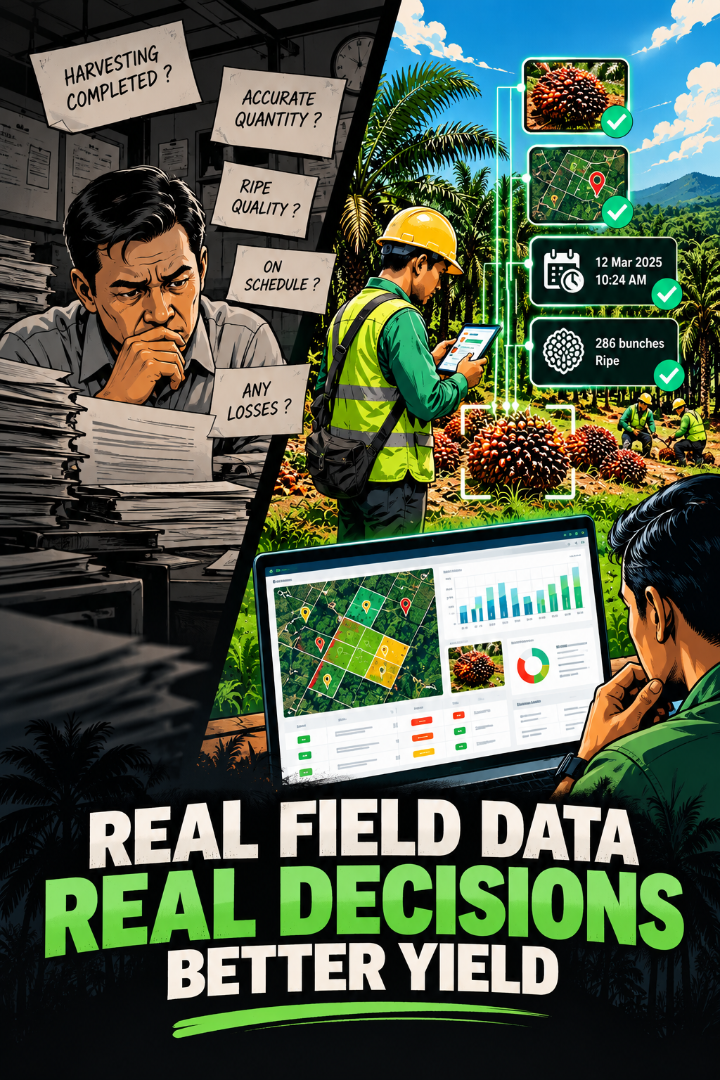
In oil palm plantation management, the difference between a good report and a well-managed operation can be significant.
An estate may report that harvesting was completed on schedule, fertiliser was applied according to plan, and field losses were kept under control. But how can management be certain that the work was performed correctly, at the right location and at the right time?
Traditional plantation management often relies on reports prepared by supervisors and estate personnel after field activities have taken place. When management depends primarily on these reports, it can be difficult to establish exactly what happened in the field, when it happened, and whether the reported results accurately reflect the actual operation.
This is where Visibility & Awareness, the second pillar of Plantec Behavioural Management, becomes critical.
Through ABS Global’s Plantec solutions, operational information is captured at the source — the field — and made available through the Plantec dashboard and website. GPS-tagged records, date and time information, task identification, FFB quantity and quality data, and photo evidence help create a more reliable picture of daily plantation operations.
But Plantec’s purpose goes beyond collecting data.
When work is recorded with supporting evidence and reflected in operational monitoring, it changes the way people approach their responsibilities. Harvesters become more conscious of harvesting standards. Supervisors become more accountable for completing work on schedule. Estate managers gain better information for allocating resources, addressing losses and monitoring operational performance.
This is behavioural management through operational visibility.
Plantec helps plantation businesses ensure the right work is done at the right place and at the right time — supported by evidence, accountability and data-driven decisions.
1. Visibility & Awareness: Making Actual Field Operations Visible
Visibility & Awareness is about ensuring that estate managers and headquarters can understand what is happening across plantation operations using information captured from actual field activities.
In Plantec, this principle is applied through operational modules that record work performed in the field and present the information through the system’s dashboard and website.
For oil palm estate management, this can include:
- FFB harvesting quantity and quality.
- GPS-tagged harvesting activities linked to the relevant block and task.
- Date and time records of field activities.
- Photo evidence supporting recorded FFB information.
- Harvesting interval and harvesting round monitoring.
- Field losses and the locations where they are recorded.
- FFB evacuation records.
- Fertiliser programme scheduling and application monitoring.
- Field upkeep activities and their execution against planned schedules.
These records help management move beyond relying solely on manually prepared summaries.
Instead of simply receiving a report stating that an activity has been completed, management can review the available operational records to understand what was captured, where the activity took place and when it occurred.
This creates a more transparent relationship between field execution and management reporting.
For headquarters, the same principle supports a clearer view of operational performance across estates. For estate managers, it provides information that can be used to identify delays, investigate inconsistencies and determine where intervention is required.
The result is a more informed approach to plantation management, estate operations monitoring and data-driven decision-making.
2. Harvesting Module: Capturing FFB Data at the Source
Harvesting is one of the most important operational activities in an oil palm estate. It directly influences crop recovery, FFB quality, labour productivity and the efficiency of subsequent crop evacuation.
Yet harvesting performance cannot be properly managed by looking at production totals alone.
Management also needs confidence in the information used to measure that performance.
Capturing FFB quantity and quality in the field
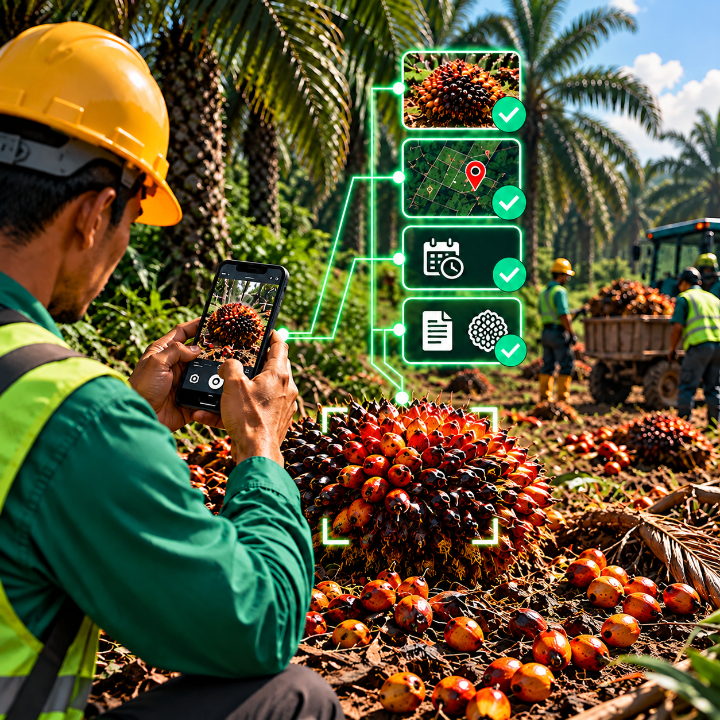
Through Plantec’s Harvesting Module, FFB quantity and quality information is captured at the point where harvesting activities take place.
The records can be associated with the relevant block and task, supported by GPS location information, date and time records, and photo evidence of the FFB.
This establishes a clearer connection between the information recorded in the system and the actual field activity.
Rather than depending entirely on figures compiled later by field personnel, management has access to operational records captured at the source.
The location and time information help establish where and when the recorded activity took place. The associated task identifies the work being performed, while photo evidence provides additional context for reviewing the recorded FFB.
These controls make discrepancies easier to identify and investigate, reducing reliance on manually prepared reports that may not fully reflect actual field conditions.
Why photo evidence matters more than it seems
A photograph of harvested FFB may appear to be a simple system feature. In practice, it can have an important behavioural effect.
When harvesters and bunch checkers know that FFB records are supported by photo evidence, they become more conscious of the accuracy of the information being submitted and the harvesting standards they are expected to follow.
Harvesters have a stronger reason to ensure that only ripe bunches are harvested. Bunch checkers have a greater responsibility to count bunches accurately and ensure that recorded quantities reflect the work performed.
If a record appears inconsistent, management has supporting evidence to review the circumstances.
This does not mean that every photograph independently proves that all harvesting standards have been followed. Rather, photo evidence strengthens the accountability of the recording process when considered alongside GPS data, timestamps, task information and field verification.
The important change is behavioural: people know that their work is documented and can be reviewed.
This encourages greater care in harvesting, counting and reporting — the everyday practices that contribute to better FFB quality and crop recovery.
3. Harvesting Interval: From Manual Reporting to Actual Operational Visibility
One of the most important applications of Plantec’s harvesting data is the monitoring of harvesting intervals.
Harvesting interval refers to the time between successive harvesting rounds in a particular block. Managing this interval is essential because harvesting must be carried out at an appropriate frequency to recover ripe bunches without allowing crops to remain unharvested for too long.
When harvesting intervals are managed primarily through manually prepared reports, the information can be affected by reporting delays, incomplete records or adjustments that make operational performance appear better than it actually is.
A report may indicate that harvesting is on schedule, while the underlying field activity tells a different story.
How Plantec changes harvesting interval monitoring
Plantec captures harvesting information against the relevant block and date. These records feed into the system’s harvesting interval information, allowing management to review harvesting rounds and intervals based on the activities recorded in Plantec.
The interval information is retained in the system rather than depending solely on a separately prepared manual report.
This gives management a more consistent basis for examining:
- How many harvesting rounds have been recorded for a block.
- When harvesting took place during each recorded round.
- The interval between harvesting rounds.
- Whether a block is approaching or exceeding its planned harvesting interval.
- Which blocks require follow-up because harvesting is delayed.
- Where further investigation is needed into harvesting progress or scheduling.
The system provides visibility into the recorded activity. Managers can then use that information to determine whether the actual operation is progressing as intended.
Why harvesting interval matters for yield
Consider a block that should be harvested according to its planned schedule but remains unattended longer than expected.
If the delay is not visible to management, ripe bunches may remain unharvested, crop recovery may be affected, and the operation may lose opportunities to collect available FFB at the appropriate time.
With harvesting interval information available through Plantec, the estate manager can identify the delayed block and investigate the cause.
Is the harvesting team short of manpower? Has the harvester spent too much time in another block? Is the crop distribution different from expectations? Is access to the field affecting productivity?
These are questions that require operational investigation, but the recorded interval provides a clear starting point.
Management can then decide whether to reallocate harvesters, deploy additional workers, adjust the harvesting schedule or address another operational constraint.
There is also an important agronomic consideration: the purpose is not simply to shorten every interval indiscriminately. Harvesting frequency must reflect crop maturity, field conditions and the estate’s operating requirements. The objective is to harvest at the appropriate time and recover ripe bunches effectively.
Changing supervisor behaviour through accountability
This is where harvesting interval becomes more than a monitoring feature.
When the interval reflects recorded field activity, supervisors have less opportunity to rely on manually prepared reports to make harvesting performance appear better than it is. Delays and deviations become more visible, and discrepancies can be investigated against the available records.
To maintain good performance, supervisors must focus on the actual operation: ensuring that harvesters are deployed appropriately, blocks are harvested according to schedule and issues are addressed before they become recurring problems.
The behavioural change is clear.
Instead of concentrating primarily on producing a good report, supervisors have a stronger incentive to ensure that the work itself is completed properly.
Plantec shifts the focus from reporting that harvesting is on schedule to managing the operation so that harvesting is actually completed on schedule.
That is the kind of behavioural change that Visibility & Awareness is designed to support.
4. Field Losses: Knowing Where Crop Recovery Needs Attention
Field losses are another area where operational visibility can make a meaningful difference.
Losses may occur when ripe bunches are missed, loose fruits are not collected, harvested FFB remains uncollected or other avoidable losses occur during field operations.
When losses are recorded without clear location information, management may know that a problem exists but struggle to determine where intervention is most needed.
Plantec helps make recorded field losses more actionable by connecting loss information with the locations where the observations are captured.
From recording losses to recovering them
With field loss records and geographical information available, estate managers can identify areas that require inspection and direct recovery efforts towards the relevant locations.
For example, if a particular block repeatedly records loose-fruit losses, the manager can investigate the cause, assign workers to collect recoverable loose fruits and verify that the identified area has been attended to.
If harvesting losses are associated with a specific area, management can review the harvesting activity and determine whether the problem relates to harvesting practices, supervision, collection arrangements or other field conditions.
The same principle applies to the allocation of recovery workers.
Rather than deploying workers based only on broad assumptions about where losses may be occurring, managers can use recorded locations to make more informed decisions about where manpower should be directed.
This helps ensure that recovery efforts are focused on the areas where they are most needed.
The objective is not merely to record how much loss has occurred. It is to make losses visible, identify their causes and recover as much avoidable crop as practicable.
By connecting field loss information with location-specific action, Plantec supports FFB loss monitoring, crop recovery, harvesting management and yield improvement.
5. FFB Evacuation: Monitoring the Movement of Harvested Crop
Harvesting is only one part of the crop recovery process. Once FFB has been harvested, it must also be collected and evacuated through the estate’s transport and handling operations.
Delays in evacuation can create operational bottlenecks, leave harvested bunches waiting in the field and complicate the coordination of harvesting and collection activities.
For this reason, harvesting data should not be considered in isolation from evacuation information.
When harvesting and FFB evacuation records are available for review through Plantec, management can examine the relationship between recorded crop production and evacuation activity.
For example, if a block records harvesting activity but the expected evacuation information is missing or delayed, the manager can investigate whether collection has been completed, whether records are outstanding or whether an operational constraint has occurred.
The discrepancy does not automatically prove that crop has been lost. It highlights an area requiring verification.
This enables management to investigate issues while the relevant information is still useful for operational follow-up.
It can also support decisions about deploying tractors, transport resources or collection workers where the evidence indicates that additional assistance is required.
For estate managers, this creates better visibility of the connection between harvesting and evacuation. For headquarters, it provides a stronger basis for reviewing recurring crop movement challenges and identifying opportunities to improve operational coordination.
The result is better-informed FFB evacuation management, plantation logistics and crop recovery decisions.
6. Fertiliser and Field Upkeep: Ensuring Planned Work Is Executed Correctly
The principles of Visibility & Awareness extend beyond harvesting.
In plantation management, activities such as fertiliser application and field upkeep must be carried out according to operational plans. These activities require appropriate scheduling, workforce allocation, supervision and verification of execution.
A fertiliser programme, for example, may specify when fertiliser should be applied, which areas are to be treated and the required application dosage.
Creating the programme is only the beginning. Management must also ensure that the planned work is delivered correctly.
Visibility of fertiliser application
With fertiliser programme information and field execution records available through Plantec, management can review progress against the intended schedule and investigate deviations.
The key questions are practical:
- Was the fertiliser application carried out at the planned time?
- Was the correct area covered?
- Was the prescribed dosage applied?
- Was the application performed according to the required method?
- If the activity was delayed, what caused the delay?
- What action is needed to complete or correct the work?
Where the system captures the relevant information, records can be used to support verification of application activities and management follow-up.
A delayed fertiliser programme should not simply disappear into a revised report. It should prompt management to understand the reason for the delay and determine the appropriate corrective action.
Similarly, recording that an activity has been completed should not replace the need to verify that it was carried out according to the programme.
The behavioural impact on staff
The same principle applies to field upkeep, including activities such as weeding, pruning and other scheduled maintenance work.
When planned activities and their recorded execution are visible, supervisors and staff become more accountable for completing work according to the required schedule and standard.
The objective is not to create more administrative reporting. It is to establish a stronger connection between the operational plan, actual execution and management follow-up.
This supports better field upkeep management, fertiliser management, estate planning and plantation operational control.
It also reinforces a central principle of Plantec: creating a plan is not enough. The organisation must ensure that the right work is performed correctly, at the right location and at the right time.
7. Plantec Is Not About Controlling Staff Movements
An important distinction must be made between monitoring operational execution and controlling where employees move throughout the day.
Plantec’s purpose is not to control every movement of estate staff. Its purpose is to make operational activities visible so management can establish whether the required work is being performed as intended.
The focus is on the work, the task, the location, the timing and the outcome.
For harvesting, that means understanding whether the assigned block was harvested according to schedule and whether the recorded FFB information reflects the field activity.
For fertiliser application, it means checking whether the planned programme was executed at the correct location, at the appropriate time and according to the required dosage and application method.
For field upkeep, it means monitoring whether scheduled work was completed and identifying outstanding activities that require follow-up.
This is a different approach from simply tracking staff presence or movement.
The objective is to ensure the right work is done at the right place during the right time.
That distinction is essential because operational performance depends not only on attendance, but also on execution.
A worker may be present in the estate without completing the required task. A supervisor may submit a report indicating completion without having sufficient evidence to verify the result. A fertiliser programme may be approved but not executed according to schedule.
Plantec’s role is to help close the gap between planned work, recorded execution and management understanding.
This encourages a culture where people are accountable for the work they are responsible for completing, rather than simply demonstrating that they were present or submitting a report.
8. How Estate Managers Use Plantec to Make Better Decisions
Visibility becomes valuable when managers can use the information to decide what to do next.
Through the Plantec dashboard and website, estate managers can review available operational information and use it to identify priorities, investigate issues and allocate resources.
Consider several practical examples.
- Scenario 1: Harvesting is falling behind schedule.
- Harvesting interval information indicates that a block has exceeded its planned interval. The estate manager investigates the reason and discovers that the assigned harvesting team cannot complete the scheduled area within the available time.
- The manager can then consider assigning additional harvesters, reallocating manpower or adjusting the operational plan, depending on the circumstances.
- Scenario 2: Field losses are concentrated in a particular area.
- Recorded loss information identifies a location requiring attention. The estate manager directs a team to inspect the area and recover loose fruits or other recoverable crop. Follow-up confirms whether the work has been completed.
- Scenario 3: FFB quality records indicate recurring concerns.
- Management reviews the relevant records and supporting evidence, investigates harvesting practices and reinforces the required standards where necessary.
- Scenario 4: Fertiliser application is delayed.
- The manager reviews the planned programme and available execution records, establishes the cause of the delay and determines how the outstanding work should be completed.
Across all four scenarios, the principle is the same: operational data helps management identify what requires attention, while management judgement determines the appropriate response.
This makes daily estate management more proactive and evidence-based.
It also supports more effective manpower allocation, harvesting supervision, field recovery and operational planning.
9. From Estate Management to Headquarters: One Operational Picture
The benefits of operational visibility extend beyond the individual estate.
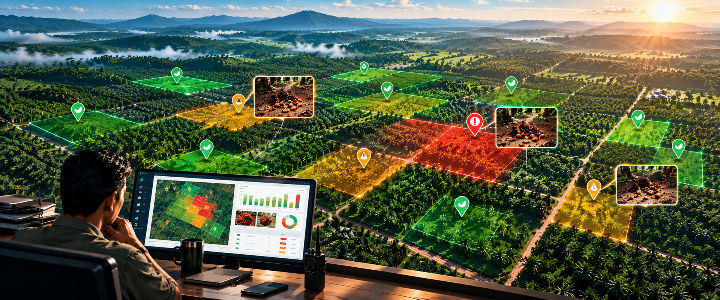
Headquarters needs a reliable basis for reviewing operational performance across different estates, understanding recurring challenges and deciding where management attention or additional support is required.
When field activities are captured consistently and presented through Plantec, the information can provide a stronger foundation for operational reviews.
Headquarters can examine the data available across estates to identify performance variations, recurring issues and areas that warrant further investigation.
For example, differences in harvesting intervals may indicate that some estates require closer review of harvesting schedules or workforce allocation.
Recurring field losses may highlight opportunities to improve collection practices or strengthen operational supervision.
Delays in fertiliser application may prompt a review of planning, resource availability or execution procedures.
These comparisons must take into account relevant differences between estates, including crop conditions, estate size and operational constraints. The purpose is not to rank estates using raw figures alone, but to understand performance and identify opportunities for improvement.
More importantly, the same information can support a common standard of accountability.
Estate personnel know that operational performance is reflected in the system’s records. Headquarters has a clearer basis for asking questions and following up on reported results. Estate managers can respond with field evidence rather than relying entirely on manually prepared summaries.
This supports plantation performance monitoring, operational visibility, management information systems and data-driven plantation management.
10. Behavioural Management: Changing How People Work
The defining value of Plantec is not simply that it digitises plantation operations.
It is that operational visibility can influence the behaviour of the people responsible for executing and managing those operations.
When harvesting activities are captured at the source, supported by evidence and reflected in harvesting interval information, supervisors have a stronger incentive to ensure that harvesting is completed according to schedule.
When FFB quantity and quality records can be reviewed against supporting information, harvesters and bunch checkers have a stronger incentive to follow the required standards and record information accurately.
When fertiliser programmes and field upkeep activities are monitored against their planned execution, supervisors have a stronger responsibility to ensure that the work is completed correctly and delays are properly addressed.
When field losses are recorded at identifiable locations, management can direct recovery efforts towards the areas that require attention.
These are practical behavioural changes.
The system makes operational performance more visible, reduces dependence on manually prepared reports and creates a clearer basis for accountability. Staff and supervisors are encouraged to focus on actual execution because the recorded operation becomes an important part of management decision-making.
The intended result is not to punish people for every deviation. It is to establish a working environment where expectations are clear, performance can be reviewed, problems are addressed and corrective action is followed through.
Technology enables the visibility. Management establishes the expectations. People change their behaviour through the way work is planned, executed and reviewed.
This is what distinguishes behaviour-driven plantation management from simply implementing a digital reporting system.
11. How Visibility & Awareness Contributes to Yield Improvement
Yield improvement requires more than technology. It depends on agronomic conditions, crop maturity, harvesting practices, workforce performance, operational planning and the effective recovery of available crop.
However, management cannot consistently address operational problems that it cannot see or understand.
Plantec supports a more informed approach by making relevant operational information available for review and action.
|
What becomes visible |
What management can do |
Intended operational benefit |
|
Harvesting quantity and interval |
Identify delayed blocks and investigate harvesting performance |
More timely harvesting |
|
FFB quality and supporting evidence |
Investigate quality issues and reinforce harvesting standards |
Better FFB quality |
|
Field loss locations |
Direct recovery workers to areas requiring attention |
Reduced avoidable crop losses |
|
Harvesting and evacuation records |
Investigate crop movement gaps and improve coordination |
Better crop recovery |
|
Fertiliser programme execution |
Address delays and verify application against requirements |
Better adherence to the agronomic programme |
|
Field upkeep progress |
Identify outstanding work and improve execution |
More consistent field maintenance |
|
Operational performance across estates |
Identify recurring problems and direct management attention |
More informed planning and resource allocation |
The impact depends on whether the information is accurate, the underlying causes are correctly identified and management follows through with effective action.
Nevertheless, the approach provides a practical foundation for improving plantation operations.
When managers can identify delayed harvesting, investigate recurring losses, verify field activities and allocate workers according to operational needs, they are better equipped to recover available crop and address avoidable inefficiencies.
Over time, these improvements can contribute to better FFB recovery, stronger harvesting performance, improved operational productivity and yield improvement.
The ultimate objective is not to generate more data. It is to make better use of the data already being captured to improve the results of daily plantation operations.
Conclusion: Better Visibility. Better Behaviour. Better Yield.
Visibility & Awareness, the second pillar of Plantec Behavioural Management, is built on a simple principle: operational performance improves when people have better information and are accountable for how work is executed.
By capturing operational data at the source, connecting records to relevant locations and activities, and making the information available through the Plantec dashboard and website, ABS Global helps plantation management develop a clearer picture of daily estate operations.
Harvesting records and intervals help reveal whether blocks are being harvested according to schedule. FFB quality information and photo evidence strengthen the basis for reviewing harvesting practices. Field loss records help management identify where recovery efforts should be directed. Evacuation information supports the investigation of crop movement gaps. Fertiliser and field upkeep monitoring helps establish whether planned work is being executed as intended.
" More importantly, this visibility influences behaviour."
Harvesters become more conscious of harvesting standards and accurate recording. Supervisors become more accountable for ensuring that operations are completed according to schedule. Estate managers gain a stronger basis for allocating resources and addressing operational issues. Headquarters gains a clearer view of the information needed to review performance and support decisions.
Plantec is not about controlling staff movements. It is about ensuring that the right work is done at the right place during the right time — and that management has reliable information to understand, verify and improve the outcome.
When operational data is used consistently to guide decisions and corrective action, visibility becomes a practical driver of behavioural change.
And when behaviour improves, plantation operations have a stronger foundation for recovering avoidable losses, improving FFB quality, strengthening productivity and driving better yield.
That is Visibility & Awareness in practice: making the operation visible, making people accountable and turning field information into better decisions.
Discover ABS Global
ABS Global provides digital solutions that support plantation management, estate operations and data-driven decision-making.
Explore how ABS Global and Plantec can help your organisation strengthen operational visibility, improve harvesting management and build a more accountable, performance-driven plantation operation.
ABS Global — Better People. Better Ways. Better Impact.
Quantum Leap Improvements.