Proactive Field Inspection in Oil Palm Estates: Recovering Hidden Yield Losses
Pillar #1 — Proactive Inspection
Planter’s rule: Walk the field. See the condition. Find the loss. Recover it.
In an oil palm estate, yield is not determined only by how much fertiliser is applied, how efficiently harvesting is organised or how many tonnes are sent to the mill.
Sometimes, the yield is already there.
It is simply left behind in the field.
A ripe fresh fruit bunch (FFB) that was missed.
Loose fruits that were not collected.
A harvested bunch left behind.
An unripe bunch accidentally cut.
Poorly maintained palm circles.
Fronds placed incorrectly.
Field conditions that quietly deteriorate between harvesting rounds.
These may appear to be small operational discrepancies.
Collectively, they become losses.
And this is where the first Plantec behavioural pillar begins:
Proactive Inspection.
The Most Basic Tool in Plantation Management: Walking
Modern agriculture has drones.
- Satellites.
- GPS.
- Mobile applications.
- Artificial intelligence.
- IoT sensors.
- Real-time dashboards.
But before all of these technologies can create value, there is still one remarkably simple activity that remains fundamental to oil palm estate management:
Walk the field.
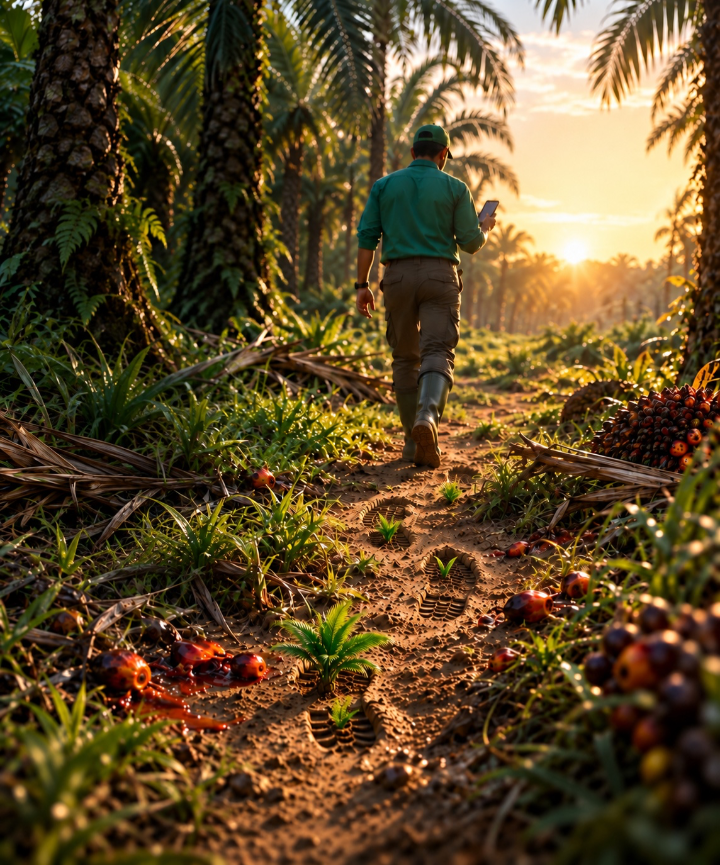
Experienced planters have understood this for generations.
“A planter’s footprint is fertilizer for the palms.”
The saying captures something important about plantation management.
A field cannot be properly understood from an office.
Reports can tell you what was recorded.
Dashboards can show you what was submitted.
Data can highlight where something may be wrong.
But the field tells you what is actually happening.
That is why field inspection remains a backbone of effective oil palm plantation operations.
What Is Proactive Field Inspection?
Proactive field inspection is more than simply checking whether harvesting has been completed.
It is a structured post-harvesting field inspection designed to identify operational discrepancies, recover losses and ensure that field conditions remain according to the required standard.
After harvesting, the inspection team walks through the field and looks for evidence of:
- Uncollected ripe FFB
- Unharvested ripe bunches
- Uncollected loose fruits (LF)
- Harvested FFB left behind
- Accidentally harvested unripe bunches
- Hidden or abandoned bunches
- Poor loose-fruit collection
- Incorrect frond stacking
- Poor palm-circle cleanliness
- Incomplete field work
- Other discrepancies affecting field performance
The objective is simple:
Find it. Record it. Act on it. Recover it.
This is where field inspection moves beyond routine checking and becomes a yield improvement activity.
The Loss Is Not Always at the Mill
When people talk about palm oil losses, attention can naturally move towards mill operations, oil extraction rate (OER), processing efficiency and mill losses.
Those are important.
But losses can begin much earlier.
They can begin in the field.
The Malaysian Palm Oil Board (MPOB) has highlighted that harvesting efficiency affects recoverable FFB, palm oil and palm kernel yield. Its research also notes that loose fruits left uncollected represent a harvesting loss, while delays can affect both fruit weight and oil quality.
MPOB has also identified poor supervision as a practical cause associated with unharvested bunches, uncollected loose fruits and other harvesting problems.
This is why plantation management and harvesting management cannot be separated from yield management.
The field is the beginning of the value chain.
The First Loss: The Ripe Bunch Nobody Harvested
Imagine a harvesting team completes a harvesting round.
On paper, the work may look complete.
But a post-harvesting inspection discovers ripe FFB still hanging on several palms.
That is a discrepancy.
And if nobody walks the field, it may remain there until the next harvesting round.
By then, the opportunity has already changed.
The purpose of proactive inspection is therefore not to blame the harvester.
It is to identify the operational gap while there is still an opportunity to recover it.
The inspector finds the discrepancy.
The loss is recorded.
The responsible team is informed.
Corrective action is taken.
The FFB is recovered.
That is behavioural management in action.
The Second Loss: Loose Fruits Left on the Ground
Loose fruit collection is another simple but important part of oil palm harvesting.
Loose fruits are not simply debris.
They are part of the recoverable crop.
MPOB notes that loose fruits are an indicator of bunch ripeness and that fruits detached during harvesting need to be collected to maximise the oil content recovered during processing.
Yet loose fruit collection can easily become neglected, particularly when labour availability and harvesting pressure are challenging.
MPOB has specifically identified labour shortages as a factor affecting loose fruit collection.
This makes the post-harvesting field inspection particularly valuable.
Walk the palm circle.
Look around the harvested bunch location.
Check the ground.
Find the loose fruits.
Record the discrepancy.
Recover them.
Small fruits. Real yield.
The Third Loss: The Bunch That Was Cut but Never Collected
Another common field discrepancy is a harvested FFB that has been cut but remains in the field.
It may be hidden under fronds.
It may be placed away from the collection point.
It may simply have been missed during evacuation.
From the office, the harvesting activity may appear completed.
On the ground, the crop is still sitting there.
This is why field inspection is fundamentally different from field reporting.
Reporting tells you what someone says happened.
Inspection verifies what actually happened.
That distinction is incredibly important in agricultural operations management.
Look Beyond Harvesting
A strong field inspection should not become a one-item checklist.
The inspector should look at the whole field condition.
For example:
Palm Circle Cleanliness
Frond Stacking
Unripe Bunches
Field Upkeep
Is the area around the palm adequately maintained?
Are loose fruits visible?
Is excessive debris making harvesting and collection difficult?
Are fronds stacked in the intended location?
Are they obstructing access?
Are they affecting field accessibility or harvesting?
Were any unripe bunches accidentally harvested?
Are there bunches left hidden in the field?
Are harvesting practices being followed?
Are other field tasks being carried out according to the required standard?
Is there evidence of incomplete work?
Are discrepancies appearing repeatedly in the same block?
This is where field inspection becomes field intelligence.
Every Discrepancy Is a Potential Loss
At Plantec, we look at these discrepancies differently.
They are not simply mistakes to be recorded.
They are recoverable opportunities.
An uncollected FFB is potential yield.
Uncollected loose fruit is potential yield.
An unharvested ripe bunch is potential yield.
Poor field execution can become future productivity loss.
Repeated operational discrepancies can become a management problem.
So the inspection process should not end when the inspector records the finding.
It should continue until someone takes action.
From Field Observation to Digital Action
This is where digital plantation management can strengthen a traditional plantation practice.
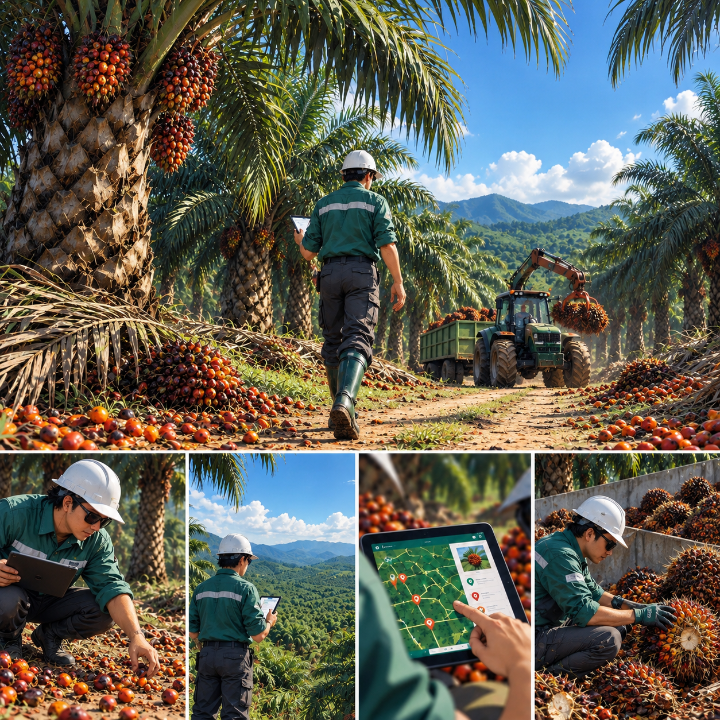
A field inspection using Plantec can turn an observation into a structured digital record.
Instead of:
“There are some losses in Block A.”
Management can have a much more actionable picture:
Where?
What?
How much?
Who needs to act?
When was it found?
What action was taken?
Was the loss recovered?
That creates operational visibility.
The information can be recorded in Plantec and made available to management for follow-up.
The manager can then take corrective action to recover the identified losses.
This creates a closed operational loop:
INSPECT → IDENTIFY → RECORD → ACT → RECOVER → VERIFY
That is much more powerful than simply generating another report.
Turning Field Inspection Into Yield Improvement
This is where the connection between behaviour and technology becomes clear.
Technology does not walk the field.
People do.
Plantec does not replace the planter’s footprint.
It makes that footprint visible, measurable and actionable.
The field team performs the inspection.
The system captures the information.
Management sees the discrepancy.
Action is assigned.
The loss is recovered.
The result contributes to better FFB recovery and stronger yield performance.
That is the essence of behaviour-driven digital transformation.
Why Walking Still Matters in Digital Agriculture
There is sometimes a misconception that digital agriculture means reducing the need for people to be in the field.
The opposite can be true.
Good digital agriculture can make field presence more purposeful.
Instead of walking without a clear objective, teams can use operational data to focus their attention.
Instead of collecting information on paper, field inspection can become structured digital data.
Instead of waiting for monthly reports, management can gain faster operational visibility.
Instead of discovering recurring problems much later, managers can identify patterns and take earlier action.
Digital tools therefore don’t replace the planter.
They amplify the planter’s ability to see, understand and act.
Proactive Inspection Creates a Different Management Culture
There is also a deeper behavioural change happening here.
A reactive estate asks:
“What went wrong?”
A proactive estate asks:
“What can we find and correct before it becomes a bigger problem?”
That difference matters.
It changes how supervisors behave.
It changes how field teams work.
It changes what managers look for.
And eventually, it changes the culture of the plantation.
This is why Proactive Inspection is the first pillar of the Plantec behavioural framework.
It establishes the habit of being present, looking closely and acting early.
The Technology Behind the Behaviour
This is also where ABS comes in.
ABS develops the technology and digital systems that support the behavioural framework behind Plantec.
The goal is not simply to create another plantation management software or agriculture management system.
The goal is to enable better agricultural operations.
That means connecting:
Field Inspection
↓
Digital Field Data
↓
Operational Visibility
↓
Management Action
↓
Loss Recovery
↓
Yield & Productivity Improvement
This is the connection between digital plantation management and real-world plantation performance.
The Quantum Reaction Begins With a Walk
Our broader Quantum Leap Improvements philosophy is built around a simple reaction:
People + Technology + Process + Data → Improvement → Performance
Proactive Inspection is where that reaction starts on the ground.
The person walks.
The field reveals the condition.
The inspection identifies the discrepancy.
The technology records it.
Management acts.
The operation recovers the loss.
And the organisation learns.
That is how a basic estate practice becomes a data-driven plantation management process.
The Oldest Technology in the Estate May Still Be the Best One
Before drones.
Before satellite imagery.
Before AI.
Before IoT.
Before dashboards.
There was the planter walking through the palms.
Looking.
Checking.
Thinking.
Questioning.
Correcting.
Following up.
That behaviour remains relevant today.
Technology simply gives us a better way to capture what the planter sees and turn those observations into actionable agricultural data.
Because ultimately, a plantation cannot be managed entirely from a screen.
Someone still has to walk the field.
And when that walk is systematic, recorded, followed up and acted upon, it becomes much more than an inspection.
It becomes a yield improvement strategy.
From Footprints to Results
The idea behind Proactive Inspection is ultimately very simple.
Every footprint represents presence.
Every observation represents awareness.
Every recorded discrepancy represents accountability.
Every action represents improvement.
And every recovered loss contributes to better operational performance.
So perhaps the old planter’s saying still holds true:
“The Best Fertilizer is The Planter’s Foot Prints.”
Because sometimes the first step toward higher yield is not adding something to the palm.
It is putting your feet in the field.
--
ABS.Global