Precision Agriculture: Driving Sustainable Palm Oil Operations Through People, Profit & Planet
How operational visibility, workforce behaviour and data-driven management can transform sustainability ambitions into everyday practice.
Sustainability Begins with How We Operate
Sustainability in the palm oil industry is often discussed through environmental protection, certification, compliance and reporting. While these remain important, the sustainability of an operation is also determined by something much closer to the ground: how people work, how resources are managed and how operational decisions are made every day.
A plantation’s performance is shaped by thousands of activities across its estates and mills. Harvesting, fertiliser application, field upkeep, FFB evacuation, workforce management and processing efficiency all contribute to the overall productivity and sustainability of the operation.
These activities are interconnected. Poor execution can lead to avoidable losses, inefficient resource utilisation, inconsistent performance and recurring operational problems.
This is why sustainability cannot exist only as a policy or an objective. It must be embedded into the way operations are managed.
At its core, sustainable plantation management should balance three fundamental pillars:
People. Profit. Planet.
Together, they represent a simple but meaningful philosophy: developing people, strengthening business performance and managing resources responsibly.
Sustainability Starts at Root Cause
Many operational challenges in oil palm estates are not isolated incidents. They are often the result of recurring activities, behavioural gaps, inconsistent execution, insufficient supervision or limited visibility into actual field conditions.
Consider harvesting, loose fruit collection, fertiliser application, field upkeep and FFB evacuation. Each activity may appear routine, yet the way it is performed can influence productivity, operational costs, resource utilisation and long-term performance.
The challenge is not merely identifying that a problem exists. It is understanding where it happens, why it happens and what needs to change.
Without reliable operational information, management may see the final result without understanding the underlying cause. Decisions are then made based on assumptions, incomplete reports or observations that may not reflect actual conditions on the ground.
Sustainable improvement begins by addressing problems at their root.
This requires operational data captured as close as possible to the actual activity, providing a clearer understanding of what is happening, where it is happening and how it can be improved.
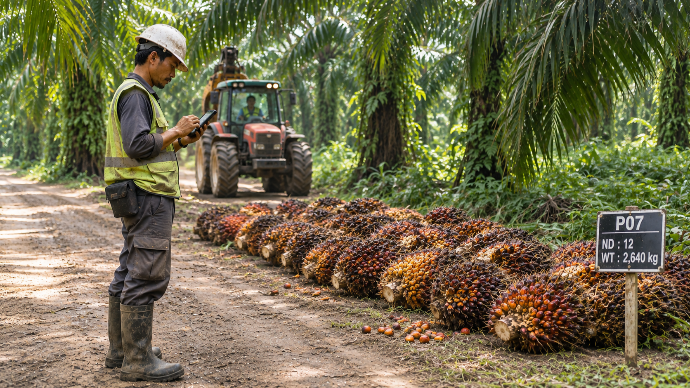
Precision Agriculture: Beyond Technology
Precision Agriculture is commonly associated with drones, sensors, satellite imagery, automation and advanced analytics.
However, precision in plantation management extends beyond technology.
It is also about knowing:
- Where an activity is performed.
- When it is performed.
- What was actually carried out.
- Whether it meets the required standard.
- What issues were identified.
- What action needs to be taken.
Technology becomes meaningful when it provides an accurate picture of operational reality.
In oil palm plantation management, the quality of information depends heavily on the accuracy of activities performed and recorded at source. When operational data is captured consistently, management gains greater visibility into field conditions, work execution, performance gaps and areas requiring attention.
Precision Agriculture, therefore, is not simply about introducing technology into agriculture. It is about enabling more precise operational management through better information, better decisions and better execution.
But technology alone cannot create operational discipline.
At the centre of every operation remains the human factor.
Plantec: Connecting Behaviour, Data and Improvement
Technology can provide information. People determine how work is executed.
This is the fundamental principle behind Plantec.
Plantec focuses on the behaviours required to build disciplined, visible and continuously improving plantation operations. Its framework is built around eight behavioural pillars:
1. Proactive Inspection
2. Visibility & Awareness
3. Active Supervision
4. Prevention Management
5. Planning & Predictability
6. Precision
7. Recognition
8. Skills Coaching
Identifyi operational issues, irregularities and potential problems before they escalate.
Creating awareness of actual field conditions, activities and operational performance.
Ensuring work is monitored, responsibilities are understood and activities are executed properly.
Addressing potential problems before they develop into larger operational issues.
Strengthening operational preparation, consistency and the ability to anticipate requirements.
Improve accuracy in execution, information, monitoring and decision-making.
Reinforcing positive behaviour, responsible execution and performance.
Developing people through continuous learning, guidance and improvement.
These pillars work together.
Inspection identifies what is happening. Visibility creates awareness. Supervision strengthens execution. Prevention addresses potential risks. Planning improves predictability. Precision strengthens accuracy. Recognition reinforces positive behaviour. Skills Coaching develops the people responsible for improvement.
Together, they create a framework where operational issues can be identified, understood, addressed and improved systematically.
The objective is not simply to digitise existing processes.
It is to strengthen the way people think, work, manage and improve.
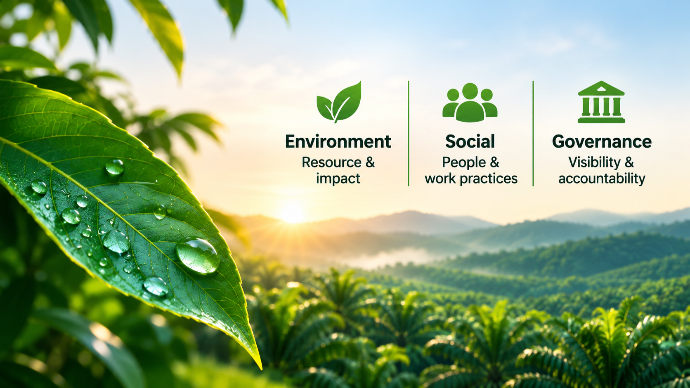
Bridging ESG Ambitions with Operational Reality
Environmental, Social and Governance (ESG) has become an important consideration in how organisations approach sustainability, responsibility and long-term business resilience.
However, sustainability ambitions alone do not create operational impact.
Policies establish expectations. Standards define requirements. Frameworks provide direction. But the effectiveness of these commitments ultimately depends on how they are translated into daily practices.
Environmental responsibility requires more than commitments. It involves responsible resource management, proper planning, operational discipline and awareness of activities that influence environmental performance.
Social responsibility extends beyond policies concerning workers. It includes workforce capability, skills development, supervision, accountability, working practices and the behaviours that shape daily operations.
Governance must extend beyond documents and procedures. Effective operational governance requires visibility, reliable records, accountability, monitoring and the ability to identify issues and follow through with corrective actions.
Precision Agriculture and digital plantation management can help provide operational visibility and structured information. Plantec’s behavioural pillars help connect that visibility with inspection, supervision, planning, prevention, coaching and continuous improvement.
This does not replace ESG frameworks, sustainability reporting, audits or certification requirements.
Instead, it addresses a fundamental question:
How do we translate sustainability expectations into the way our operations are actually managed?
Sustainability becomes more meaningful when it is reflected in everyday activities, the way people work, the resources they use and the decisions management makes.
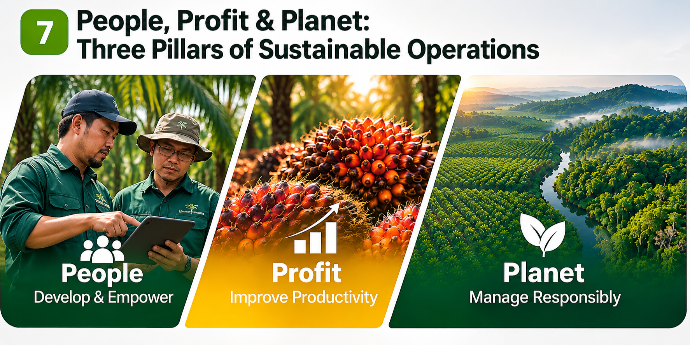
People, Profit & Planet: Three Pillars of Sustainable Operations
Sustainable plantation management is not about pursuing one outcome at the expense of another. It requires a balance between workforce development, business performance and responsible resource management.
People — Developing a Better Workforce
People are the foundation of plantation operations.
Improving workforce capability, behaviour, accountability and awareness can create a more disciplined working environment. Through proactive inspection, active supervision, recognition and skills coaching, organisations can develop a workforce that understands its responsibilities and performs with greater consistency.
The objective is not simply to manage people.
It is to develop people who understand their work, recognise operational issues, take responsibility and contribute to continuous improvement.
Better people create the foundation for better operations.
Profit — Improving Performance and Productivity
Profitability and sustainability are closely connected.
Operational inefficiencies, avoidable losses, inconsistent execution and poor resource utilisation can affect both business performance and long-term viability.
Better visibility into harvesting, loose fruit collection, FFB evacuation, fertiliser management, labour utilisation and field upkeep can help management identify opportunities for improvement.
When operational issues are understood at their root cause, management can make more informed decisions about resource allocation, priorities and the practices that require improvement.
The objective is not simply to produce more.
It is to improve productivity, reduce avoidable inefficiencies and strengthen the long-term viability of plantation operations.
A sustainable operation must also be a well-managed and economically resilient operation.
Planet — Managing Resources Responsibly
Environmental responsibility begins with how resources are managed.
Plantation operations involve fertiliser, machinery, manpower, transportation, energy and other resources. Their effectiveness depends not only on availability, but also on planning, application, monitoring and responsible execution.
Better operational visibility can support improved planning, more disciplined activities, resource utilisation and the identification of operational gaps.
Through accurate information, responsible practices and continuous monitoring, plantation management can better understand where improvement opportunities exist and how operational decisions can contribute to more sustainable resource management.
The Planet pillar is not about making environmental promises.
It is about strengthening the operational discipline required to manage resources responsibly.
Connecting Estate and Mill Operations
Sustainable plantation management should not stop at the estate.
The relationship between estate operations and palm oil mill operations is equally important. FFB quality, harvesting practices, evacuation timing, grading, processing efficiency and operational losses are interconnected.
At the estate level, management needs visibility into harvesting performance, field upkeep, fertiliser activities, labour execution and FFB evacuation.
At the mill level, management must maintain oversight of FFB intake, weighing, grading, processing performance, extraction rates, production losses and operational efficiency.
When estate and mill operations are managed with greater visibility, organisations can better understand how activities upstream influence performance downstream.
A more connected operational view can help identify gaps, improve the flow of operational information and strengthen decision-making throughout the palm oil value chain.
Sustainability is not limited to a single department or activity. It requires a coordinated understanding of the entire operation.
From Operational Data to Sustainable Outcomes
Data collection alone does not create improvement.
The real value of operational data lies in what organisations do with it.
Information captured at source can provide visibility into activities, performance, recurring issues and operational gaps. When analysed meaningfully, it can help management understand root causes rather than merely observe symptoms.
The process must be continuous:
Inspect → Identify → Record → Analyse → Act → Improve
This cycle connects daily operational activities with management decisions.
It creates an opportunity to move from reactive management to proactive management, from assumptions to evidence and from isolated problem-solving to continuous improvement.
When people, processes and information work together, organisations are better positioned to improve performance while managing resources more responsibly.
This is where technology, operational discipline and workforce behaviour converge.
Sustainability Is How We Operate
The future of sustainable palm oil cannot be shaped by technology alone, nor by policies and commitments alone.
It requires people who understand their responsibilities, operations that are managed with precision, decisions supported by reliable information and organisations committed to continuous improvement.
ESG provides the broader sustainability expectations.
Precision Agriculture provides greater operational visibility.
Plantec connects operational visibility with workforce behaviour, discipline and improvement.
And People, Profit and Planet represent the outcomes we strive to strengthen through better operational management.
Sustainability is not just about what an organisation declares.
It is reflected in how people work, how resources are managed, how operations are executed and how improvements are made every day.
Better People. Better Profit. Better Planet.
ABS Global — Quantum Leap Improvements.