From digital investment to management discipline
In my previous article, “Digital Transformation Is a Leadership Discipline — Not an IT Project,” I shared a simple view:
Digital transformation succeeds when technology changes the way people manage, decide and act.
But that raises a bigger question for plantation owners, CEOs, Managing Directors and senior operations leaders:
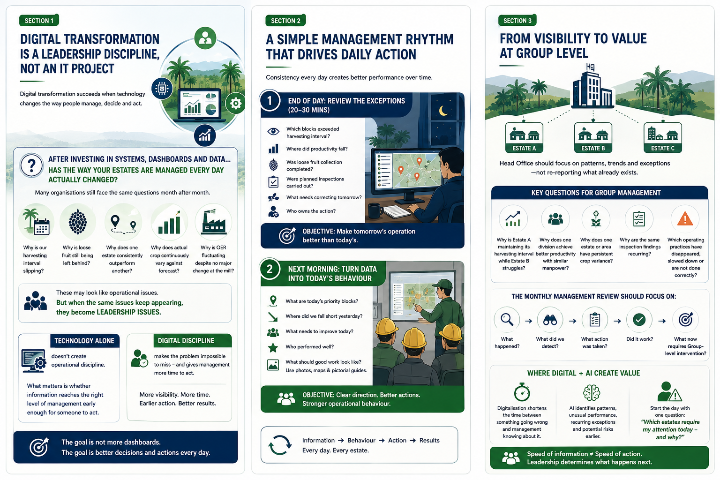
After investing in systems, dashboards and data, has the way your estates are managed every day actually changed?
After more than 10 years working with plantation groups across Malaysia and the region, I believe this is where much of the real opportunity still sits.
Some groups have sophisticated digital platforms.
Others still depend heavily on spreadsheets, WhatsApp and manual reporting.
Yet at management meetings, many of the questions remain surprisingly similar:
→ Why is our harvesting interval slipping? → Why is loose fruit still being left behind? → Why does one estate consistently outperform another? → Why does actual crop continuously vary against forecast? → Why is OER fluctuating despite no major change at the mill?
These may look like operational issues.
But when the same issues keep appearing month after month, they become leadership issues.
The question is not whether you have a system
Some of the best-managed estates I’ve worked with were operating with relatively simple tools.
I’ve also seen organisations invest significantly in digital systems and still struggle with familiar operational problems.
That taught me something important.
Technology alone doesn’t create operational discipline.
What matters is whether information reaches the right level of management early enough for someone to act.
I’ve seen estates where harvesting intervals had drifted to 17–25 days.
In more extreme situations, I’ve encountered blocks where the interval had stretched to 45 or even 60+ days.
The information existed.
It was being recorded.
But identifying the affected blocks manually took time, and meaningful review often happened too late.
When this happens, estate management eventually becomes a firefighting team:
Which blocks can we save now? Which ones will have to wait for another round?
At that point, management is no longer controlling the harvesting programme.
The harvesting programme is controlling management.
With digitalisation, the same information can be analysed automatically and problem blocks highlighted on the same day.
Management no longer needs to spend hours finding the problem.
They can spend that time managing it.
With earlier visibility and consistent management action, I’ve seen estates bring harvesting intervals back towards 13–17 days, and in better-performing situations towards 10–13 days — in some cases, without increasing the existing labour force.
The technology didn’t harvest a single bunch.
It simply made the problem impossible to miss — and gave management more time to act.
This is where senior leadership matters
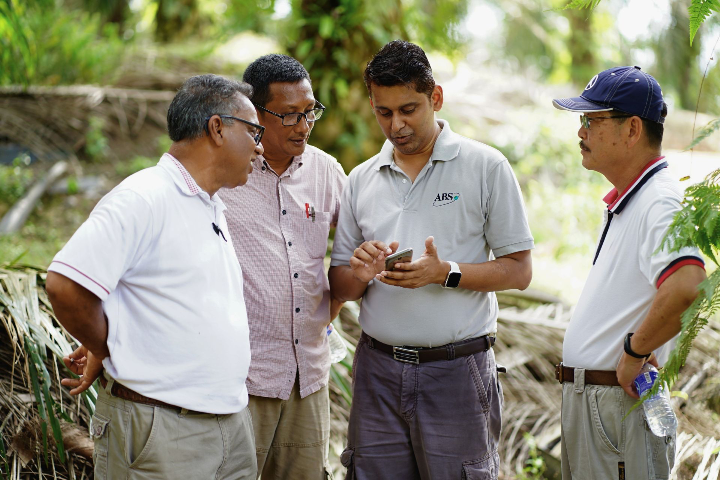
A CEO or Group Head of Operations shouldn’t need to manage harvesting intervals block by block.
That’s not the role of senior leadership.
But senior leadership should create the management discipline that makes sure somebody does.
For me, that means asking a different set of questions.
Not simply:
“Do we have the data?”
But:
“Who reviews it?”
“How often?”
“What happens when performance moves outside our expected range?”
“Who owns the corrective action?”
“Do we know whether it was actually carried out?”
“Do we have the visibility and traceability to follow it through?”
Those questions tell you far more about the maturity of an operation than the number of dashboards installed.
A simple management rhythm can change a lot
At estate level, I believe one of the most effective disciplines is also one of the simplest.
🌙 End of day: review the exceptions
Spend 20–30 minutes looking at what didn’t go according to plan.
Which blocks exceeded harvesting interval?
Where did productivity fall?
Was loose fruit collection completed?
Were planned inspections carried out?
What needs correcting tomorrow?
And most importantly:
Who owns the action?
The objective isn’t another report for Head Office.
The objective is to make tomorrow’s operation better than today’s.
☀️ The next morning: turn yesterday’s data into today’s behaviour
Morning muster is where the review becomes action.
Staff and workers don’t need another dashboard.
They need clarity.
What are today’s priority blocks?
Where did we fall short yesterday?
What needs to improve today?
Who performed well?
What should good work look like?
Photos, maps and simple pictorial guides can often communicate this more effectively than lengthy instructions.
This is where information becomes operational behaviour.
What should Head Office be looking for?
This is where I believe the conversation becomes more important at Group level.
Head Office shouldn’t become another layer of operational checking.
And where a digital system already captures operational performance, estate teams shouldn’t have to spend days reproducing the same information into another set of monthly reports:
Yield statistics.
Harvesting rounds.
Productivity.
Crop variance.
Field activities.
Inspection performance.
If this information already exists in the system, senior leadership should be able to access it.
The management meeting should not be where Head Office first discovers an operational problem.
That, to me, is one of the biggest opportunities digitalisation creates.
Instead of spending management meetings going through numbers that describe what has already happened, Group management can focus on patterns, trends and exceptions across estates.
Why is Estate A maintaining its harvesting interval while Estate B continuously struggles?
Why does one division consistently achieve better productivity with similar manpower?
Why does one estate or area have persistent crop variance?
Why are the same inspection findings recurring?
Which operating practices have disappeared, slowed down or are no longer being carried out correctly?
These are no longer individual field issues.
They are management signals.
And when digital systems are properly designed and used, senior leadership should be able to see those signals without waiting for month-end presentations.
The monthly management review can then become a very different conversation:
What happened?
What did we detect?
What action was taken?
Did it work?
What now requires Group-level intervention?
That, to me, is a much better use of management time.
Where digital and AI actually create value
For conventionally managed estates, digitalisation can dramatically reduce the time between something going wrong and management knowing about it.
That alone is valuable.
But for organisations that are already digital, the next opportunity is bigger.
AI can help identify patterns across estates, highlight unusual performance, detect recurring exceptions and identify potential risks earlier.
Imagine senior management starting the day with one question:
“Which estates require my attention today — and why?”
Instead of going through hundreds of KPIs looking for the answer.
That’s where I see AI becoming genuinely useful in plantation management.
But there is an important distinction.
Speed of information is not the same as speed of action.
If an exception is identified but nobody acts, the technology has achieved very little.
Digitalisation shortens the time to insight.
AI can improve the quality of that insight.
Leadership still determines what happens next.
The question I would ask at the next management meeting
Whether your organisation still operates conventionally or has already invested heavily in digital transformation, I would ask one question:
“Has our investment changed the way our operations are managed every day?”
If the answer is yes, you should be seeing it in the behaviour and results of the organisation.
Problems identified earlier.
Faster corrective action.
Better field supervision.
More consistent harvesting intervals.
Lower crop variance.
Better productivity.
And ultimately, more predictable yield, OER and profitability.
If the answer is no, the organisation may not need another system yet.
It may need to get more value from the information and technology it already has.
That brings me back to the point from my previous article:
Digital transformation is a leadership discipline.
But I would take that one step further.
Digitalisation shortens the time to see the problem.
Management discipline shortens the time to act on it.
And that is where digital investment starts turning into operational performance.
For plantation owners, CEOs, MDs and operations leaders:
How do you know whether digitalisation has actually changed the way your estates are being managed — beyond simply giving you better reports?
I’d be interested to hear how different plantation groups approach this.
Country Head, Malaysia | ABS Innovations Sdn. Bhd.
Helping plantation and manufacturing organisations align leadership, process, digital transformation and AI to deliver measurable improvements in yield, productivity and profitability.
#OperationsExcellence #PlantationManagement #OilPalm #DigitalTransformation #AIForOperations #Leadership